


Rubber Mixing Line Guide From Internal Mixer to Batch Off Cooling
Rubber Mixing Line Guide From Internal Mixer to Batch Off Cooling
A rubber mixing line is a fixed sequence of machines that turns bales, powders and liquids into a cooled, stackable sheet. Material enters at one end as polymer, carbon black, oil and curatives. It leaves at the other end as a flat sheet on a pallet, below 40 °C, dusted so it will not stick to itself.
Between those two points the compound passes through three jobs that cannot be reordered: dispersive mixing, forming, and thermal stabilisation. Each one decides a different property. And most line problems I see start with the same mistake, which is buying them as three separate machines instead of one chain.
What each stage actually decides
Read that third column as a diagnostic. If the sheet has white specks, the cooling line is not the problem and no adjustment there will help.
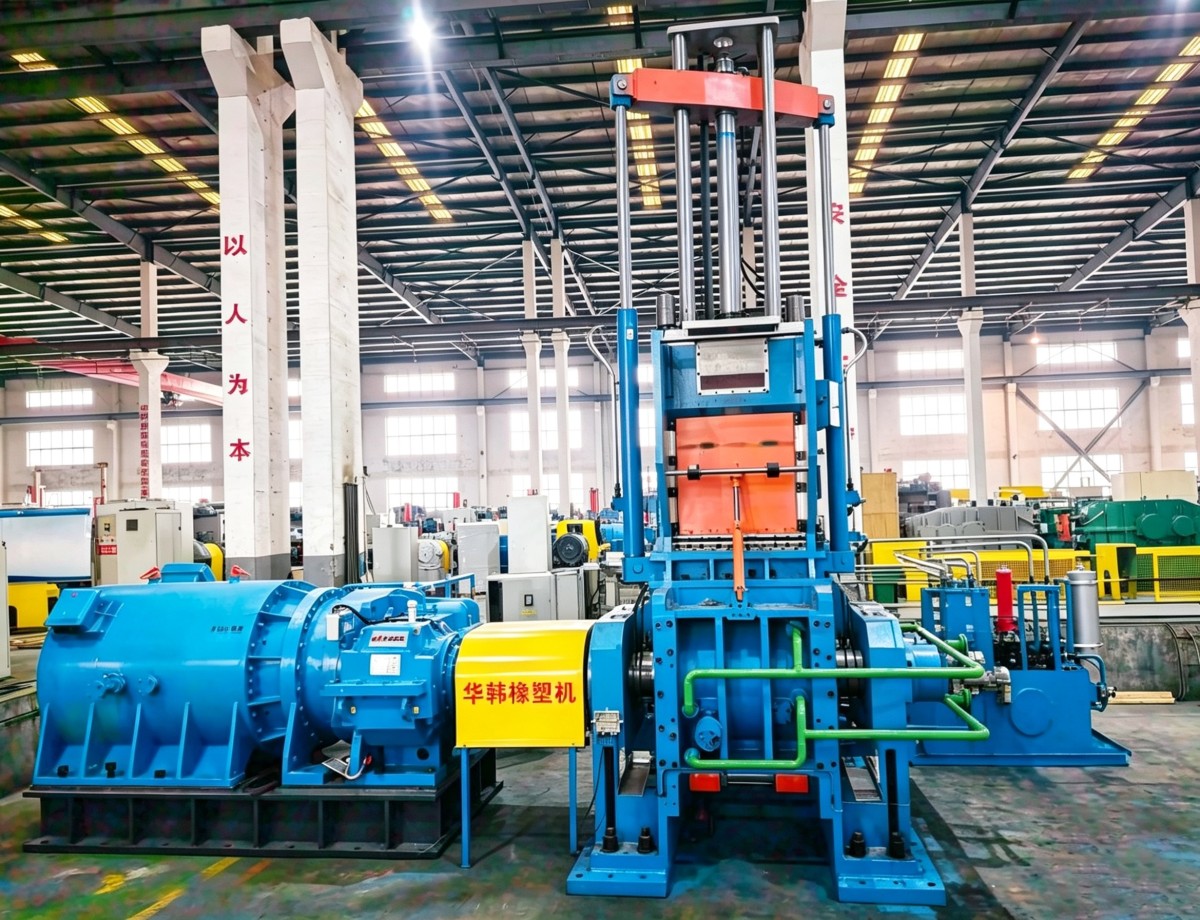
Stage one sets the ceiling for everything after it
A sheeter cannot repair poor dispersion, and a cooling line cannot rescue a batch that was discharged too hot. Whatever comes out of the chamber is what the rest of the line works with.
Three numbers matter more than the machine's nameplate:
Fill factor. Production internal mixers normally run at 0.65 to 0.75 of chamber volume. Underfilled, the rotors spend their energy stirring air and the shear that breaks down filler never develops. Overfilled, the ram cannot seat, compound escapes past the seals, and discharge temperature climbs sharply in the last minute of the cycle.
Discharge temperature. For sulfur-cured diene compounds, the usual target is below roughly 100 to 110 °C once curatives are in. Peroxide systems are less forgiving because decomposition is purely thermal, so the margin is smaller and there is no useful way to buy it back afterwards.
Cycle time. A production internal mixer typically completes a batch in 8 to 18 minutes. An open mill doing the same compound takes 20 to 40 minutes, and a good part of that difference is the operator, not the steel.
Stage two is where labour enters the line
The second stage has two common answers, and choosing between them is a staffing decision as much as a technical one.
An open mill uses two counter-rotating rolls. The operator cuts the band, folds it back into the nip, and judges the compound by eye and by feel. That is not a weakness. On colour compounds and short specialty runs it is the fastest feedback loop in the plant.
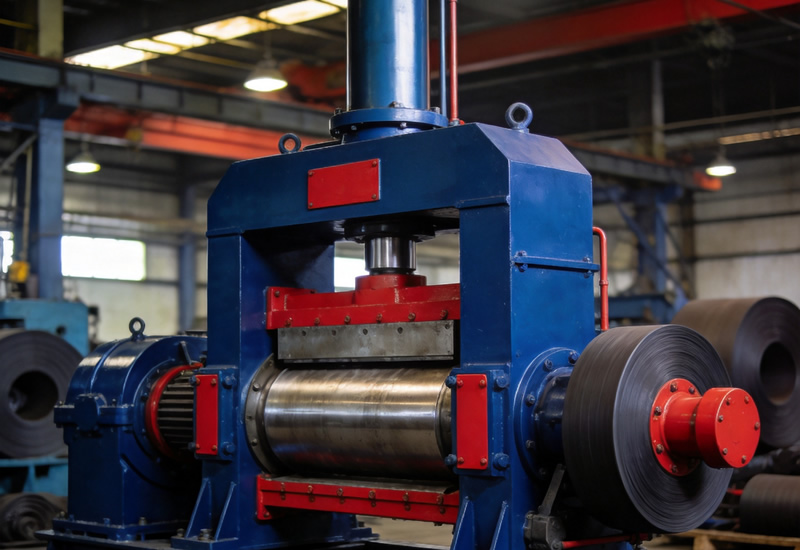
A twin-screw extruding sheeter takes the batch straight from the mixer, homogenises it with two conical screws, and pushes it through a roller die as a continuous sheet. Nobody stands at the rolls. Screw speed and roll speed are interlocked so the sheet does not stretch or pile up.
The practical difference shows up in a place most buyers do not look at first. With an open mill, throughput is capped by one person's attention for the whole shift. With a sheeter, throughput is capped by the cooling line downstream, which is a much easier constraint to fix.
Stage three is a process step, not a conveyor
Rubber conducts heat badly. A 10 mm sheet that leaves the mixer at 120 °C can feel cool on the surface while the middle is still soft, and if you stack it at that point you have created a problem that shows up two days later as blocked sheets or a batch that will not feed.
Two things happen during cooling, and only one of them is about temperature.
The first is thermal: you need to get the sheet below about 40 °C before stacking. The second is chemical. While the batch stays hot, viscosity keeps drifting and the scorch margin keeps shrinking. A batch that measured comfortably on the Mooney at discharge can be marginal after sitting in a warm stack overnight.
That is why the cooling unit does three jobs in sequence rather than one: cool, dip in anti-tack, dry. Skip the dry and you trade sticking for condensation.
Where lines get mismatched
Size the line backwards
The instinct is to pick a mixer, then find equipment that fits around it. Doing it that way usually produces a line whose slowest element is the cheapest one.
Start from the batch size and cycle you actually need. Multiply out to kg/h. Size the cooling line on that figure at its shortest cycle. Then size the sheeter on the sheet width and thickness your next process can accept. The mixer is the last thing to confirm, because it is the one component with enough adjustment range to absorb a mistake.
If the compound is temperature-sensitive, run the arithmetic again with a longer cycle. Silica compounds and high-loading EPDM mixes rarely hit their dispersion targets at the speed the catalogue quotes, and the cooling line sized for the catalogue speed will be oversized and under-used.
FAQ
Is a mixing line the same as a mixing room?
The line is the machine sequence. The room is the building, the dust extraction, the material flow and the weighing area around it. You can have a good line in a badly laid out room and lose most of the benefit to transport and waiting.
Can I run an internal mixer with no batch-off cooling?
You can, and plenty of small plants do, by stacking sheets on stillage and letting them cool in air. What you lose is repeatability. Air cooling depends on the weather, the stack height and how long the pallet sits, so the batch you feed tomorrow is not quite the batch you mixed today.
Do I need an open mill if I already have a sheeter?
Not for sheeting. You may still want one for final curative addition at low temperature, for colour changes, or as the place where a scorched batch gets rescued. Plants that run many formulas keep a mill for exactly that reason.
What discharge temperature should I target?
Below roughly 100 to 110 °C for sulfur systems once the curatives are incorporated. Masterbatch stages without curatives can run hotter. Measure it every batch; estimating from the cooling water temperature is how batches get ruined quietly.
How many mixers can one cooling line serve?
Two, in practice, and only if the cooling length covers the second mixer's discharge while the first sheet is still travelling. Beyond that you are not cooling, you are queueing.
Hot News

Huahan Showcases Complete Mixing Line Solutions at International Rubber Expo
Our booth presented the full rubber processing portfolio, drawing customers from tire groups and hose manufacturers across Europe, the Middle East and Southeast Asia.
Read Article →Skilled Workforce and R&D Team Continues to Grow
The Huahan team now exceeds 500 employees, including mechanical design, electrical control, process engineering and after-sales service groups.
Read Article →New Intermeshing Kneader Technology Improves Dispersion Quality
Our engineering team introduced an upgraded intermeshing rotor design delivering more uniform filler dispersion and lower mixing temperatures.
Read Article →


{item.title}
{item.description}
PLANNING A NEW RUBBER PRODUCTION LINE?
Send us your process requirements — our engineers will propose a tailored machine package within 24 hours.